Approach
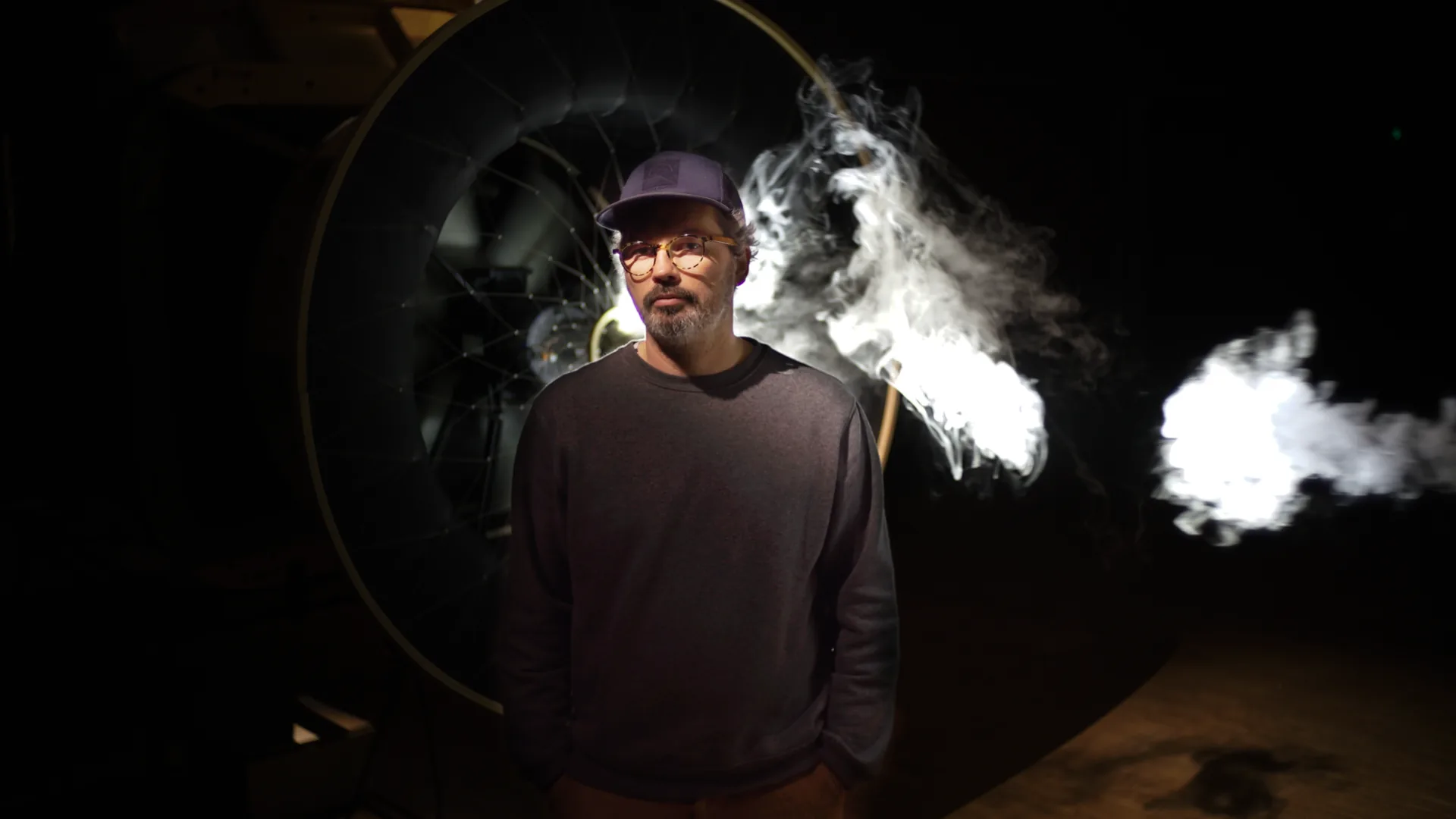
Guillaume Cousin sculpts the immaterial. Water, air, light, space and time are his materials: sensory vehicles through which he questions our relationship to reality. His installations do not show; they invite us to perceive differently.
We breathe nearly twenty thousand times a day, and yet we still call the air we could not live without for more than a few minutes “empty”. This contradiction reveals something about our relationship to the world. Reality is not a given: it is a construction, shaped by two filters, perception and culture.
The first is the filter of the living. Every species composes its own sensory world. The bee sees ultraviolet, the snake senses thermal radiation, the migrating bird finds its way by the Earth's magnetic field. Each species inhabits its own perceptual world. What we call “reality” is only one version among many.
The second filter is cultural. The great scientific revolutions have transformed the way we inhabit the world. Copernicus removed us from the centre of the Universe, Darwin placed us back among the animals, Freud revealed the limits of our consciousness. The world remained the same; only our model of it changed. In contemporary scientific discoveries, Guillaume Cousin looks for the signs of a new shift in how we see reality.
Fluids are central to this research. They flow through the body, shape landscapes and connect matter, energy and living beings. Set in motion, they reveal a world of relationships and constant transformation.
This approach echoes the agential realism of physicist Karen Barad, for whom matter is not a passive medium but an active process: phenomena emerge from the relationships that constitute them, and to perceive is already to take part.
Developed in dialogue with researchers in physics, biology and fluid mechanics, Guillaume Cousin's installations give these questions a sensory form without illustrating a theory. They invite visitors to experience the limits of their own perception. Before the movements of a fluid, the propagation of a wave or the metamorphoses of light, the gaze slows down: as when watching flames, waves or clouds, a particular kind of attention emerges. For a few moments, the viewer stops observing an object and instead experiences a world of which they are themselves one of the manifestations.
He lives and works on the Atlantic coast, in the Vendée region of France. A stage designer and lighting designer in the performing arts since the early 2000s, he has also designed the lighting and sets for many productions (Cie L'Expérience Harmaat, Compagnie S'poart, Alexi HK, Roberto Negro, Théo Ceccaldi...).